Most commercial and industrial sites make heat the same way they did decades ago: a gas boiler fires when the process calls for it. That approach is familiar and dependable. It also ties a large share of your energy budget and emissions to a single fuel source that swings with the global markets. When that fuel’s price swings, so do your operating budget and profit margins. The Henry Hub natural gas spot price rose 56% from 2024 to 2025, and delivered prices for gas, propane, and fuel oil carry their own swings on top.
Switching to electric heat removes the fuel exposure and brings a different set of challenges. An electric boiler or heat pump draws power when the process needs heat, often during peak hours. That can mean on-peak rates and high demand charges, and at larger sites, a service upgrade or a wait for the utility to add capacity.
Thermal energy storage can help with both. It banks heat for later: a storage system takes in energy when it is plentiful or inexpensive, holds it as heat in an insulated medium, and releases it hours later when a building or process needs it. Think of it as a battery for heat, one that lets you separate the energy you buy or make from when you use it. Here is how it works, and what it can do for your facility.
How thermal energy storage works
A thermal storage system has three basic parts: a way to charge it, an insulated storage medium that holds the heat, and a loop or heat exchanger that delivers the heat to your process or building when it calls for it.
Charging can come from electricity, such as off-peak grid power or on-site solar. The LDES Council describes the value plainly: by converting electricity into stored thermal energy, electric thermal storage can provide reliable industrial heat, while shifting electricity use to times when renewable generation is abundant, prices are lower, or network capacity is available.
The result is flexibility. Your process keeps its own schedule, and your energy purchasing gets its own schedule to maximize value.
Five ways thermal storage can add value
1. Lower and more predictable energy costs
Fuel prices fluctuate constantly. According to the U.S. Energy Information Administration, daily Henry Hub natural gas spot prices ranged from $2.65 to $9.86/MMBtu over 2025 alone. Those are wholesale figures, before delivery costs.
Storage lets you move your heat supply off a volatile fuel and onto energy you buy or make on your own schedule, every day of the year: onsite solar, or electricity bought during lower-priced hours. On a time-of-use tariff, you can charge when prices are low and draw down during on-peak hours, which can also help manage demand charges.
Picture a food processor running two shifts with a steady daytime steam load. With storage, that site could charge overnight or from midday solar and carry the production day on stored heat, cutting the fuel it burns across the year. We can run those numbers for you from your utility bills, fuel costs, and load data, so you can see what storage could mean for your budget before committing to anything.
2. Resilience and backup
Outages add up. EIA reports that U.S. electricity customers experienced an average of 11 hours of interruptions in 2024, the most in ten years, with major events such as hurricanes accounting for nearly nine of those hours.
A charged thermal store holds heat on site. Paired with backup power for its pumps and controls, it can help a facility ride through an outage, a fuel delivery delay or a price spike while keeping critical heat loads running. For sites on propane or fuel oil, it can also reduce how closely operations depend on the next delivery.
3. Electrify with less strain on your electrical service
An electric boiler sized to meet your heat load directly has to draw its full power whenever the process calls for heat. That sets the size of the electrical service you need and adds to the peak demand you pay for.
Storage separates when you draw power from when you use heat, so charging can be scheduled around the limits of your electrical service and your utility’s peak hours. For heat loads that swing through the day, that can mean a smaller electrical connection than an electric boiler sized for peak demand, and less new on-peak demand on your bill. Some utilities also offer rates or programs for loads that can shift away from peak hours.
4. Renewable heat around the clock
Many processes need heat at 3 a.m. as much as at noon. Solar produces in daylight, and grid prices and renewable supply shift through the day. Storage bridges those gaps, so heat drawn from renewable energy can serve a 24/7 load in place of a share of boiler firing. It’s like bottling the sunshine.
Solar output peaks at midday, which is not always when your process needs heat. At grid scale, this mismatch is already visible: EIA reports that California’s grid operator curtailed 3.4 million MWh of utility-scale wind and solar in 2024, up 29% from 2023. On your own site, storage lets you capture the full value of your onsite solar, using it for your own heat instead of exporting it to the grid at potentially lower rates.
When we model a system, we look at your potential onsite generation and energy use to match a storage system that captures the value of that energy. If you would like to see how that could look for your site, a short conversation through our Contact Us form is a good place to start.
5. Progress toward emissions targets
Boiler combustion falls under Scope 1, the emissions a company produces directly. Those are often the hardest to reduce, because they cannot be addressed by buying cleaner electricity alone.
Heat is a large slice of the emissions picture. The International Energy Agency reports that heat accounted for almost half of global final energy consumption and 38% of energy-related CO2 emissions in 2022. In the United States, the Department of Energy estimates that industrial heat accounts for about 9% of the entire U.S. emissions footprint.
DOE’s Industrial Heat Shot set a goal of cutting industrial heating emissions by 85 percent, reflecting how central heat is to industrial decarbonization. Thermal storage charged from renewables can displace fuel burned onsite, which can show up directly in a site’s Scope 1 accounting.
Emissions targets can also come from your customers. Many large companies now ask their suppliers to measure and reduce emissions, because a supplier’s emissions count toward the buyer’s own Scope 3 inventory. Cutting the fuel burned in your boilers can help you answer those requests with real numbers.
Where Durion’s HeatTrap fits
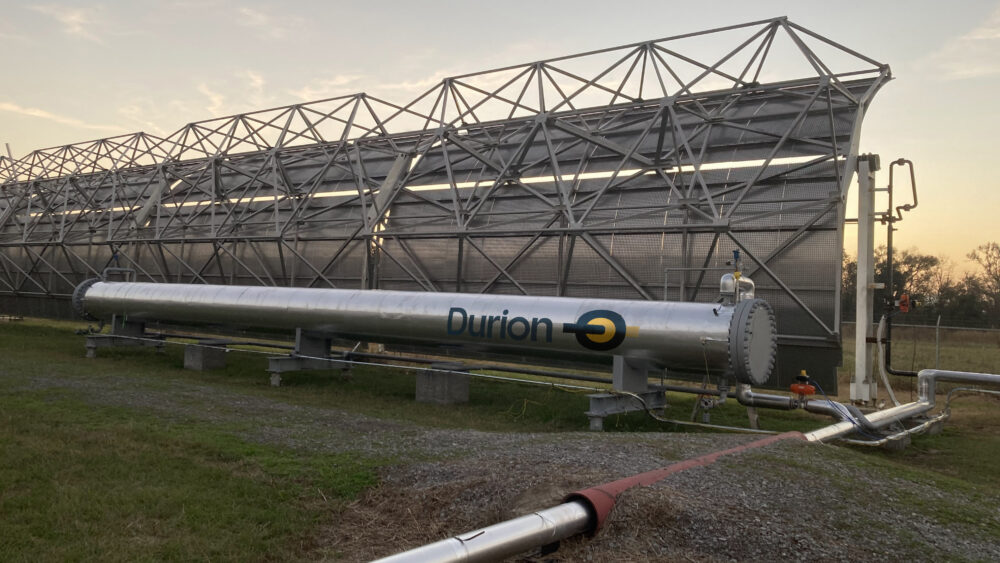
HeatTrap is Durion’s long-duration thermal storage. It charges on off-peak or renewable power, using an electric boiler during low-cost hours or a solar field where land allows, and delivers process heat to your existing header as steam or hot water, on your schedule. The same storage works either way.
You can see how it works on our Technology page.
Thermal storage for industrial heat is still building its operating record across industries and site types. Durion is working on that with partners and customers, one site at a time, and every evaluation starts from the facility’s own data.
Signs thermal storage could fit your site
Thermal storage tends to be worth a closer look when several of these apply:
- Your site has a large year-round heat load.
- Your heat comes mostly from gas, propane or fuel oil boilers.
- Your utility tariff has a meaningful gap between on-peak and off-peak prices, or meaningful demand charges.
- You have onsite solar, or space and interest in adding it.
- Your company has an emissions target that covers Scope 1, or your customers are asking suppliers like you to cut emissions.
- You plan to electrify your heat and want to keep the electrical service upgrade small.
- Heat continuity during outages matters to your operation.
None of these is a requirement on its own. Together, they suggest the numbers could be worth running.
Talk it through with us
If your site looks like a fit, or you’d just like to learn more, we would be glad to have a short conversation about your operation and see whether a free site assessment would be useful. There is no obligation, and you can decide afterward whether it makes sense to go further. Reach us through our Contact Us form.
Sources
- “Renewables 2023: Heat.” International Energy Agency (IEA), 2024 (report published January 2024). https://www.iea.org/reports/renewables-2023/heat
- “DOE Launches New Energy Earthshot to Cut Industrial Heating Emissions by 85 Percent.” U.S. Department of Energy, 2022. https://www.energy.gov/articles/doe-launches-new-energy-earthshot-cut-industrial-heating-emissions-85-percent
- “Policy Paper: Electric Thermal Energy Storage (eTES): A Strategic System Asset for Australia’s Energy Transition.” LDES Council, 2026. https://ldescouncil.com/electric-thermal-energy-storage-etes-a-strategic-system-asset-for-australias-energy-transition/
- “In 2025, U.S. natural gas spot prices increased from 2024’s record low.” U.S. Energy Information Administration, Today in Energy, 2026. https://www.eia.gov/todayinenergy/detail.php?id=66984
- “Hurricanes in 2024 led to the most hours without power in the United States in 10 years.” U.S. Energy Information Administration, Today in Energy, 2025. https://www.eia.gov/todayinenergy/detail.php?id=66744
- “Solar and wind power curtailments are increasing in California.” U.S. Energy Information Administration, Today in Energy, 2025. https://www.eia.gov/todayinenergy/detail.php?id=65364